



Why Palm Oil Export Is a Growing Opportunity.
Palm oil remains one of Africa’s most valuable agricultural exports, with demand increasing across Europe every year. It is widely used in:
- Food processing
- Cosmetics and skincare
- Industrial manufacturing
- Biofuel production
European countries import millions of tonnes annually, creating strong opportunities for Nigerian exporters, agro-business owners, and cooperatives ready to meet international standards.
For exporters who understand quality control, documentation, and buyer expectations, the palm oil business can become a long-term source of foreign income.
Step 1: Register Your Export Business
Before exporting palm oil internationally, your business should be properly registered and compliant with Nigerian export regulations.
Essential registrations include:
- Corporate Affairs Commission (CAC)
Register your business name or limited company. - Nigerian Export Promotion Council (NEPC)
Obtain your official Exporter’s Certificate. - Domiciliary Account
Open an export-friendly foreign currency account with banks such as:- GTBank
- Zenith Bank
- Access Bank
Tip: Most international buyers take exporters more seriously when they can provide an NEPC certificate.

Step 2: Understand European Product Standards
European buyers pay close attention to quality and consistency.
To improve your chances of securing repeat orders:
Buyers often expect:
✔ Refined, Bleached & Deodorised (RBD) palm oil
✔ Low Free Fatty Acid (FFA) content — preferably below 5%
✔ Proper storage in clean, sealed containers or drums
✔ Clear product labelling with:
- Batch number
- Production date
- Country of origin
Many buyers may also request:
- Laboratory test reports
- Quality certificates
- Health or safety certifications
Clean packaging and consistency can significantly increase buyer trust.
Step 3: Prepare Your Export Documents
Documentation is one of the most important parts of international trade.
Missing or incorrect paperwork can delay shipments or cause buyers to reject goods.
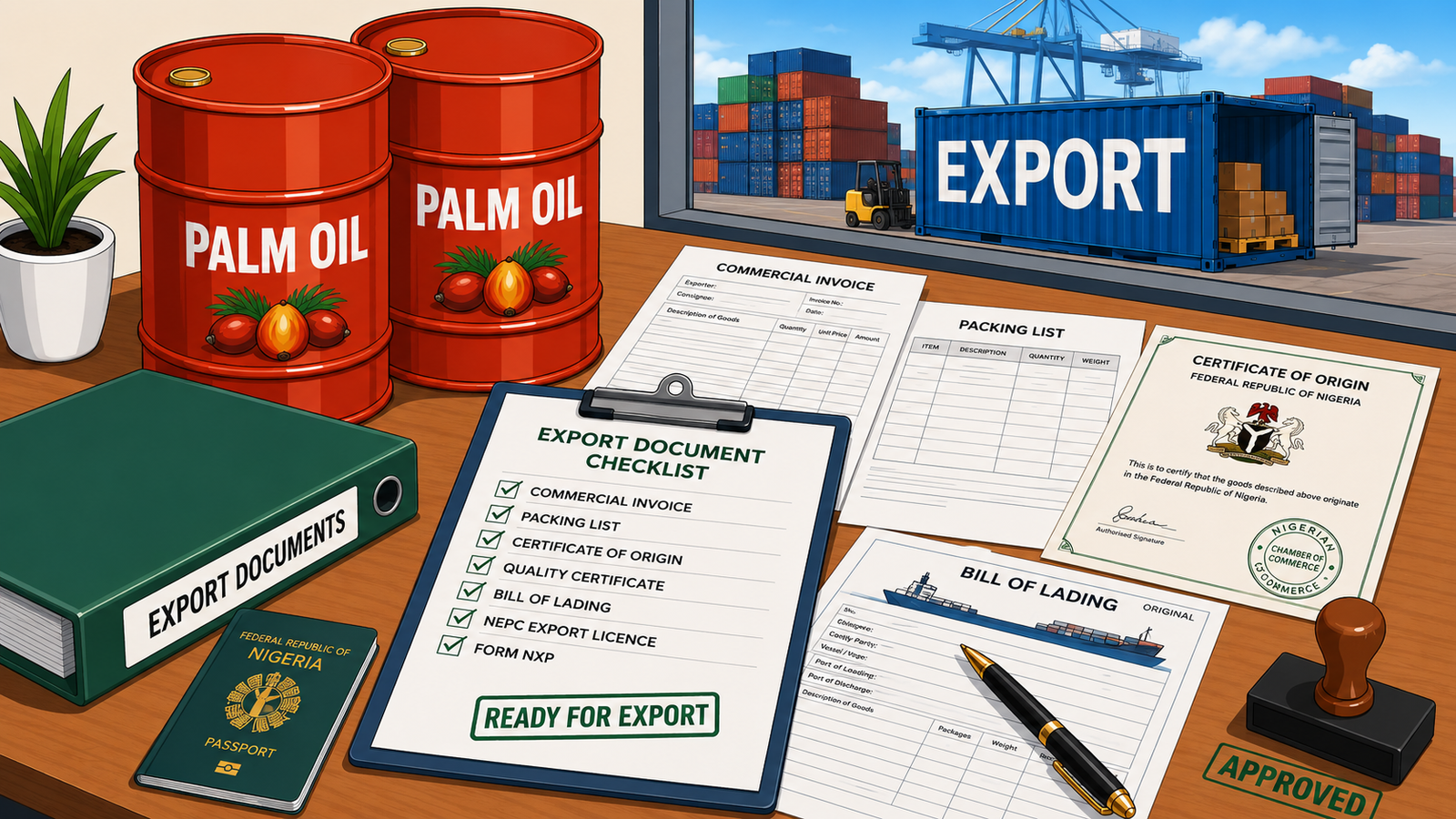
Required export documents usually include:
| Document | Purpose |
|---|---|
| Commercial Invoice | Shows product value and transaction details |
| Packing List | Lists quantity and packaging |
| Certificate of Origin | Confirms Nigerian origin |
| Quality/Health Certificate | Verifies product quality |
| Bill of Lading / Airway Bill | Shipping evidence |
| NEPC Export Licence | Confirms export registration |
| Form NXP | Mandatory export processing form |
Always double-check spelling, quantities, and shipment details before submission.
Step 4: Choose the Right Shipping Method
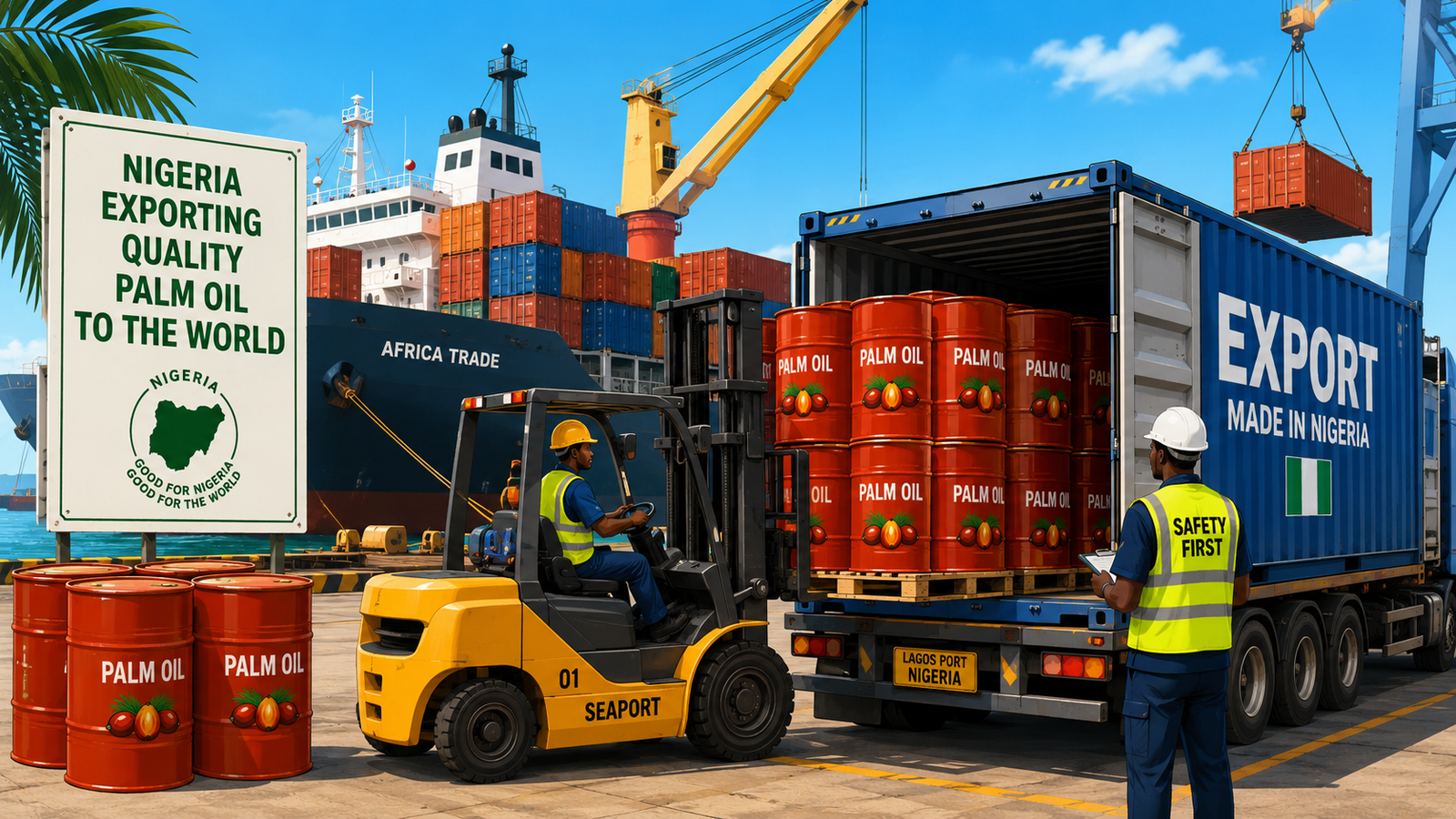
Most Nigerian palm oil exports leave through:
- Apapa Port (Lagos)
- Onne Port (Rivers State)
Common shipping terms:
FOB (Free on Board)
You deliver goods to the port.
The buyer handles freight and insurance.
CIF (Cost, Insurance & Freight)
You manage shipping, insurance, and delivery to the destination port.
For Small Exporters
If you are exporting smaller quantities, consolidated shipping can reduce freight costs and improve profit margins.
Step 5: Set Pricing and Payment Terms
Your pricing should factor in:
- Global palm oil market prices
- Freight charges
- Packaging costs
- Port handling fees
- Exchange rates
Common payment methods:
| Payment Method | Best For |
|---|---|
| Letter of Credit (LC) | Large or safer transactions |
| Telegraphic Transfer (TT) | Trusted buyers |
| Escrow Services | First-time business relationships |
Never begin production or shipment without agreed written payment terms.
Step 6: Find Reliable Buyers in Europe
Finding genuine buyers is one of the biggest challenges for new exporters.
Good places to connect with buyers:
- International trade fairs
- Chambers of commerce
- Export directories
- B2B trade platforms
- Agricultural export networks
Popular European markets include:
🇬🇧 United Kingdom
🇳🇱 Netherlands
🇩🇪 Germany
🇪🇸 Spain
Many buyers now prefer ethically sourced African palm oil from verified exporters.
Step 7: Promote Your Export Business and Get Verified.
In international trade, credibility matters.
Being listed and verified on platforms like afroexporterslink.com can help you:
- Build trust with foreign buyers
- Receive direct RFQs (Requests for Quotation)
- Increase visibility in export listings
- Appear as a verified supplier
Benefits of verification:
✔ Higher buyer confidence
✔ Better business exposure
✔ Increased enquiry opportunities
✔ Stronger professional reputation
👉 Get Verified Today and begin connecting with active buyers across Europe.

Step 8: Avoid Common Export Mistakes.
Many new exporters lose opportunities due to avoidable errors.
Common mistakes include:
❌ Using contaminated or dirty drums
❌ Mixing different oil batches
❌ Incorrect export documentation
❌ Delayed communication with buyers
❌ Hidden pricing charges
❌ Late shipment schedules
Best practice:
- Ship exactly what matches your sample
- Maintain regular communication
- Keep records for every transaction
Professionalism helps build long-term export relationships.
Final Thoughts
Exporting palm oil from Nigeria to Europe can be highly profitable when approached professionally.
By:
- registering properly,
- maintaining quality standards,
- preparing accurate documents,
- and building buyer trust,
you can grow a sustainable export business that serves international markets successfully.
Platforms like afroexporterslink.com also make it easier to connect with verified buyers and expand your export reach globally.
Ready to Start Exporting?
List your palm oil business on afroexporterslink.com and start connecting with buyers from:
- United Kingdom
- Netherlands
- Germany
- Spain
- and beyond
👉 Create Your Exporter Profile Today
.)